
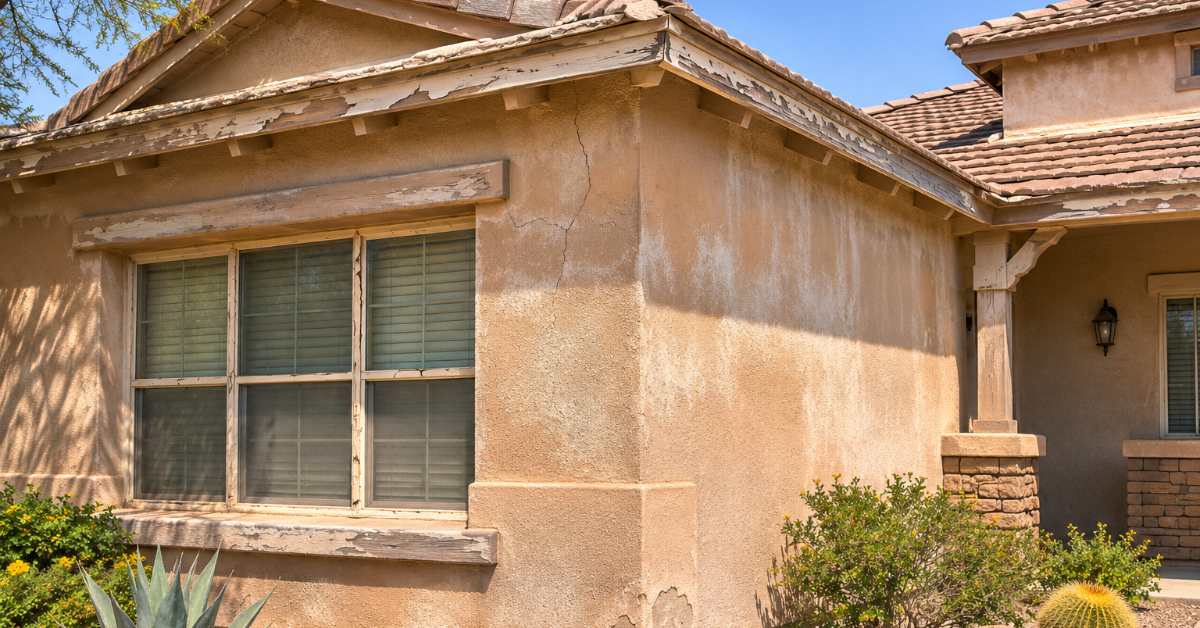
Putting off an exterior repaint can seem like an easy way to save money.
If the house still looks decent from the street, repainting may not feel urgent.
The problem is that exterior paint does more than change the color of your home.
It also helps protect stucco, fascia, trim, doors, garage doors, and other painted surfaces from sun, heat, wind, dust, and rain.
In Arizona, those surfaces deal with demanding conditions all year.
Once the coating begins to break down, waiting too long can turn a straightforward repaint into a much larger preparation and repair project.
Here is what homeowners should watch for.
Fading Is Often One of the First Signs
Arizona sun can fade exterior paint faster than many homeowners expect.
At first, the change may be subtle.
One wall may look slightly lighter than another. West- and south-facing surfaces may fade sooner. Dark colors may lose some of their richness.
Fading alone does not necessarily mean the surface underneath is damaged.
But it can be an early sign that the coating is aging.
If repainting is delayed until paint is peeling or bare material is exposed, the project may require much more preparation.
Chalking Means the Coating Is Breaking Down
Run your hand across an older painted wall.
If you pick up a powdery residue, the surface may be chalking.
Chalking can happen as exterior coatings age under UV exposure and weather.
A small amount may be normal over time.
Heavy chalking is different.
New paint should not simply be applied over a loose, powdery surface.
The wall needs to be cleaned and prepared so the new coating has a sound surface to bond to.
The more severe the chalking becomes, the more preparation may be required.
Peeling Paint Creates More Work
Peeling is one of the clearest signs that an exterior has been allowed to deteriorate.
Loose coating has to be removed before new paint goes on.
That may involve:
- Scraping
- Sanding
- Cleaning
- Spot priming
- Additional surface preparation
If repainting happens earlier, while most of the coating is still sound, prep can often be more manageable.
Waiting usually does not make peeling paint less expensive to fix.
It gives the failure more time to spread.
Failed Caulk Can Expose Vulnerable Areas
Caulk helps seal gaps around trim, windows, doors, and other exterior joints.
Arizona heat can be hard on those materials.
Over time, caulk may crack, shrink, split, or pull away.
Once that happens, water can reach areas that should stay protected.
Monsoon rain can reveal those weak points quickly.
A normal repaint often includes inspecting and repairing failed caulk.
If the problem is ignored for too long, you may find damaged wood or other surfaces that need repair before painting can begin.
Exposed Wood Can Become a Bigger Repair
Fascia, trim, doors, and other wood surfaces depend on a protective coating.
When paint wears away, the wood underneath is more exposed to sun and moisture.
That can contribute to drying, cracking, swelling, splitting, or deterioration.
At that point, paint alone may not be enough.
Some areas may need repair or replacement first.
That is one of the hidden costs of delaying a repaint until the protective coating has already failed.
Stucco Cracks Need Attention Too
Stucco is common on Arizona homes.
Small cracks can appear over time as materials expand, contract, and move.
Minor cracking may be part of normal exterior maintenance.
But it should still be evaluated.
If cracks widen, damaged areas deteriorate, or water gets into the system, repairs may become more involved.
A repaint is a good opportunity to inspect the stucco, address appropriate cracks, and create a more uniform finish.
Paint, however, should not be treated as a structural repair.
Larger or recurring cracks may need separate evaluation before coating.
Old Repairs Can Become More Noticeable
Existing homes usually have a history.
A wall may have been patched years ago.
A section of fascia may have been repaired.
A stucco area may have been touched up after another project.
As the surrounding paint fades, those older repairs can become easier to see.
That may leave the exterior looking patchy even if the coating is not peeling yet.
A full repaint can help bring repaired and weathered areas back into a more consistent appearance.
More Damage Usually Means More Labor
This is where the real cost of delaying a house repaint in Arizona starts to add up.
Painting is only one part of the project.
Preparation takes time too.
If the exterior has been neglected, the crew may need to spend more time on:
- Scraping
- Sanding
- Cleaning
- Caulking
- Patching
- Priming
- Preparing damaged surfaces
That extra work can increase the cost of the repaint.
Waiting does not always eliminate an expense.
Sometimes it simply turns a smaller maintenance project into a larger one later.
Bare Surfaces May Need Primer
When paint wears through completely, bare material may become exposed.
Those areas generally require more preparation than surfaces that still have a sound coating.
Depending on the material and coating system, spot priming may also be needed before finish coats are applied.
If large areas have become exposed, prep can increase significantly.
Catching the problem sooner may help keep the project simpler.
Paint Failure Can Point to a Moisture Problem
Peeling, bubbling, or staining is not always just a paint problem.
Sometimes it points to moisture coming from another source.
That may involve:
- A roofline
- A window or door
- Failed caulk
- Irrigation
- Flashing
- Another source of water intrusion
Painting over the symptom will not correct the cause.
If moisture is driving the paint failure, that source needs to be identified and addressed first.
Otherwise, the new coating may fail again.
Monsoon Weather Can Expose Weak Areas
Arizona monsoon storms often make existing problems more obvious.
Heavy rain and wind may reveal:
- Failed caulk
- Loose paint
- Stucco cracks
- Exposed wood
- Damaged fascia
- Water staining
The storm may not have caused the original weakness.
Often, it simply exposes an issue that was already developing.
After monsoon season, it is worth walking around the home and checking the exterior carefully.
Waiting Can Make Touch-Ups Harder
Touch-ups become more difficult as exterior paint ages.
Even if you still have the original paint color, the existing wall may have faded.
A fresh patch can stand out from the surrounding surface.
That is why small repairs on older exteriors sometimes become more noticeable after touch-up.
Once fading is widespread, repainting the entire wall or exterior may create a cleaner result than repeatedly trying to blend isolated spots.
Curb Appeal Can Decline Slowly
Exterior paint usually ages gradually.
Because homeowners see the house every day, the change can be easy to miss.
Then an older photo makes the fading obvious.
Worn trim, chalky walls, cracked caulk, and peeling fascia can also make the entire property look tired.
A repaint can make a major visual difference without changing anything about the architecture.
Delaying Affects More Than Appearance
This is the most important point.
Exterior painting is not only cosmetic.
The coating also helps protect the surfaces underneath.
Once that protection begins failing, those materials receive more direct exposure to weather.
That is why repaint timing should be based on condition.
You do not need to repaint simply because a certain number of years have passed.
Instead, look at what the exterior is actually telling you.
Signs It May Be Time to Repaint
Watch for signs such as:
- Faded color
- Heavy chalking
- Peeling or flaking paint
- Cracked coating
- Failed caulk
- Exposed wood
- Worn fascia
- Stucco cracks
- Uneven previous repairs
- Areas that no longer clean up well
One small issue does not necessarily mean the entire house needs repainting.
But several of these conditions together usually justify a closer inspection.
Repainting Earlier Can Keep the Project More Manageable
The best time to repaint is often before the exterior looks terrible.
If most of the existing coating is still sound, preparation may be more straightforward.
Once large areas start peeling, caulk fails throughout the home, or bare wood becomes exposed, the project may require more repair work.
That does not mean repainting too early.
It means paying attention to the condition of the home instead of waiting for widespread failure.
Existing Homes Need a Different Approach
iPaint Homes specializes in repainting existing homes.
That matters because an older exterior is not a blank surface.
It may have:
- Faded coatings
- Previous repairs
- Cracked caulk
- Worn trim
- Chalking
- Peeling areas
- Exposed surfaces
A good repaint starts by evaluating what is already there.
Worn and repaired areas can then be prepared appropriately before the new finish is applied.
The goal is not simply to cover the old color.
It is to create a clean, consistent finish on a home that has already been through years of weather and maintenance.
Do Not Wait for the Exterior to Fail Completely
If your home still looks good and the coating is sound, there may be no reason to repaint yet.
But if fading, chalking, failed caulk, peeling paint, or exposed surfaces are starting to appear, waiting may increase the amount of preparation and repair required later.
A repaint is often easier to manage before the exterior reaches the point of widespread failure.
iPaint Homes helps homeowners evaluate the condition of existing exteriors, prepare worn surfaces properly, and repaint homes with a clean, consistent finish.
If your Arizona home is starting to look faded or weathered, it may be worth taking a closer look before a relatively straightforward repaint becomes a much larger repair project.